Shutters become a fitted part of the window, while most blinds are a lighter and more easily changed furnishing. That distinction explains much of the difference in price, appearance and installation.
Shutters create a structured, architectural finish and can remain in place for many years. Blinds usually cost less, offer a much wider choice of fabrics and can solve particular needs such as room darkening, moisture resistance or motorised operation.
Neither is automatically better. The right choice depends on the room, window, budget and type of control you need. You can compare available options in the curtains, blinds and shutters showroom at Pendle Village, but this guide will help you narrow the choice first.
Shutters and blinds compared at a glance
| Consideration | Shutters | Blinds |
| Initial cost | Usually higher | Available across a wider range of budgets |
| Appearance | Structured and architectural | Soft, minimal, decorative or contemporary |
| Light control | Adjustable louvres and opening panels | Depends on type: raise, lower, tilt, draw or filter |
| Privacy | Particularly effective with split or tiered designs | Strong options include Venetian, vertical, pleated and privacy fabrics |
| Room darkening | Reduces light but does not normally provide full blackout | Blackout fabrics and side-channel systems offer stronger options |
| Colour and pattern | Primarily painted, wood-effect or stained finishes | Extensive choice of fabrics, prints, textures and slat finishes |
| Moisture-prone rooms | Suitable materials must be specified | Several wipeable and moisture-resistant choices available |
| Installation | Requires a detailed survey and fitted frame | Often simpler, although the system still needs accurate measuring |
| Future replacement | Intended as a longer-term installation | Generally easier and less costly to change |
What shutters do particularly well
Flexible privacy and daylight
Shutter louvres can be tilted to redirect daylight while reducing the view into the room. The panels can also be opened when you want the window completely clear.
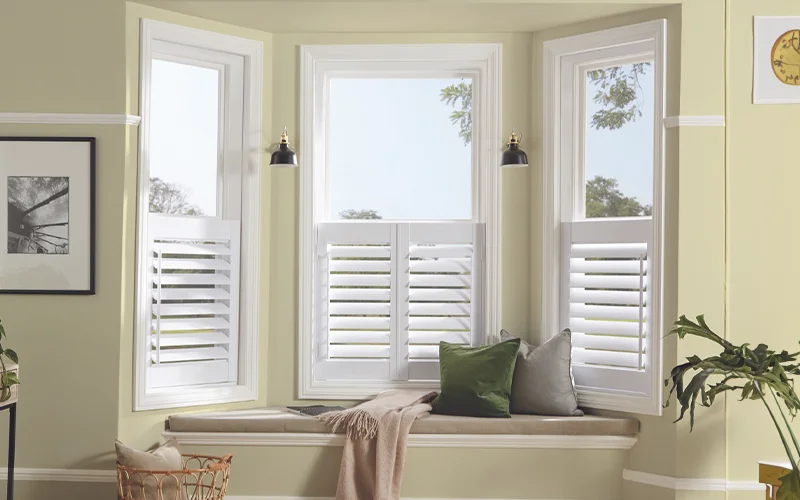
This is particularly useful on ground-floor windows facing a pavement or neighbouring property. Tier-on-tier shutters provide even more flexibility because the upper and lower sets of panels open independently. Café-style shutters cover the lower part of the window while leaving the top open to daylight.
Blinds are not limited to a single open-or-closed position, however. Venetian blinds can tilt and raise, vertical blinds tilt and draw, and some pleated systems can move from both the top and bottom. The difference is in how each product delivers that control and the look it creates in the room.
A fitted, architectural appearance
A shutter frame is made for the opening and sits as part of the window treatment rather than hanging in front of it. This works particularly well on bays, sash windows and rooms where you want a clean finish without folds of fabric.
Because shutters are closely fitted, they tend to feel more permanent than blinds. During a property sale they are often treated as a fitted item, but what remains should still be confirmed through the fixtures and fittings information agreed between buyer and seller.
It is sensible to choose a finish you will be happy to live with for some time rather than relying on an assumed increase in property value.
Additional insulation at the window
Any well-fitted internal window covering can help reduce heat transfer by creating another layer between the room and the glass. Shutters can perform well because the fitted frame and closed panels reduce air movement near the window.
They are not automatically warmer than every blind. Cellular blinds, close-fitting systems and blinds used with side channels can also provide worthwhile thermal performance. The result depends on the product, installation, window and how consistently it is closed during colder periods.
Window coverings improve comfort but do not replace appropriate glazing, draught proofing or insulation.
Where blinds have the advantage
A wider range of prices
Blinds are normally less expensive than shutters for an equivalent window, although premium fabrics, specialist systems and motorisation can narrow the difference.
This makes blinds practical when several rooms need completing at once. Some homeowners use shutters on prominent ground-floor windows and made-to-measure blinds elsewhere, but there is no need to follow the same approach throughout the house.
Greater choice of fabric, colour and texture
Shutters are usually available in painted, wood-effect or stained finishes. Blinds offer a much broader decorative range, from simple plains and textured neutrals to bold prints, translucent screens and furnishing fabrics.
This makes it easier to coordinate a blind with existing paint, flooring and furniture or to change the room later without replacing a fitted frame.
Stronger room-darkening options
Closed shutters reduce daylight, but narrow lines of light can remain between louvres, panels and frames. Solid-panel shutters can reduce more light than louvred styles, although they should not be described as completely blackout.
A blackout roller or pleated blind used with a compatible cassette and side channels can provide much stronger room darkening. The fabric alone is not enough: light can still enter around the edges of an ordinary open roller blind.
For nurseries, bedrooms or shift workers, the complete system and its installation matter more than the word “blackout” on the fabric label.
More solutions for moisture and unusual operation
Kitchens and bathrooms can use aluminium Venetians, wipeable vertical louvres, moisture-resistant roller fabrics and suitable framed blind systems. These are generally straightforward to clean and replace.
Shutters can also work in humid rooms, but the material must be approved for that environment. A moisture-resistant composite or ABS product may be more suitable than natural timber. Ventilation remains important whichever window covering is chosen.
Shutter styles explained
Full-height shutters
Full-height shutters cover the complete window and create a clean, uniform appearance. A mid-rail or split tilt arrangement can allow the upper and lower louvres to operate separately.
Tier-on-tier shutters
Two independent sets of panels cover the upper and lower parts of the window. The lower tier can remain closed for privacy while the upper tier is opened for daylight. This style is particularly useful for sash windows and rooms facing a pavement.
Café-style shutters
Café shutters cover only the lower section of the window. They preserve privacy at eye level while leaving the upper glass uncovered. They use less material than full-height shutters, although the price still depends on the window and chosen specification.
Solid-panel shutters
Solid panels contain no adjustable louvres. They create a more traditional appearance and can reduce light effectively when closed, but small amounts may still enter around the frame and panel joints.
Choosing a louvre size
Smaller louvres create a more detailed, traditional look. Wider louvres produce a cleaner appearance and give a broader view through the shutter when open.
Common sizes vary between manufacturers, so it is better to compare physical samples than choose from a number alone. You can explore the available proportions and finishes when considering made-to-measure window shutters.
Blind types explained
Roller blinds
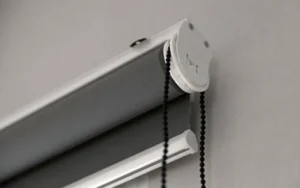
A roller blind uses a single piece of fabric wound around a tube. Options include translucent, screen, dim-out, blackout and moisture-resistant materials. Cassettes, side channels and motorisation are available on compatible systems.
Vertical blinds
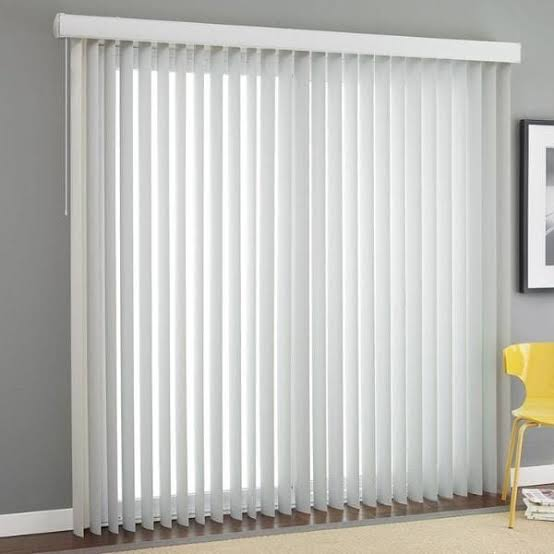
Vertical louvres rotate for privacy and light control, then draw to one side or split from the centre. They remain a practical choice for wide windows and patio doors.
Venetian and faux wood blinds
Horizontal slats can be tilted to control daylight and privacy, then raised to clear the window. Faux wood creates a shutter-inspired appearance at a lower cost, although it does not have the surrounding frame or opening panels of a shutter.
Roman blinds
Roman blinds fold into horizontal sections when raised and are made from furnishing fabric, usually with a lining. They bring softness to living rooms and bedrooms where a hard slatted finish would feel too formal.
Perfect Fit and other framed blinds
Compatible systems sit within their own slim frame and attach to suitable glazed windows or doors without conventional drilling into the main window frame. They move with an opening window or door and are useful in conservatories and on French or bifold doors.
They are not suitable for every window. The glazing bead, bead depth, handle clearance and frame construction must be checked before ordering.
Which option suits each room?
Front-facing living rooms and bay windows
Shutters offer excellent daytime privacy and create a strong, uniform finish across a bay. Venetian or pleated blinds can also provide flexible privacy at a lower cost, while curtains may be added for softness and evening comfort.
Bedrooms
If darkness is the priority, a blackout blind with effective edge control will normally outperform louvred shutters. If daytime privacy matters just as much, shutters can be paired with lined curtains or a suitable blackout blind.
Kitchens and bathrooms
Choose a product specified for moisture, splashes and regular cleaning. Aluminium Venetians, suitable roller fabrics and composite shutters can all work. The exact position of sinks, taps, handles and heat sources should be checked during measuring.
Conservatories and glazed doors
Framed or close-fitting blinds can work well because they move with each compatible door or opening pane. Shutters may also be considered, but panel movement, handles and the available stacking space must be planned carefully.
Patio doors and wide openings
Vertical and panel blinds are practical choices for wide spans. Tracked shutters can create a substantial fitted feature where there is enough room for the panels to fold or slide.
Roller blinds may also be possible, sometimes divided into more than one blind. The maximum size depends on the tube, fabric, controls and manufacturer, so there is no reliable universal limit such as 2.5 metres.
Cost, lead time and maintenance
Blinds usually cost less and often have a shorter manufacturing period than shutters. Exact lead times vary with the product, material, supplier and time of year, so confirm the expected survey, manufacture and installation dates before ordering.
Shutters are cleaned by dusting the louvres and wiping a suitable finish with a lightly damp cloth. Blinds vary: aluminium and faux wood slats can be wiped, while fabric rollers and Roman blinds need care appropriate to the textile.
Neither product lasts for a guaranteed number of years simply because of its category. Product quality, exposure to sunlight and moisture, frequency of use, installation and maintenance all influence service life.
Child safety
Cordless and inherently safe blind designs are the first choice where young children may be present. Where a blind uses an accessible looped cord or chain, the complete product and installation must comply with the applicable child-safety requirements, including any required tensioning, breakaway or securing device.
Safety devices must be fitted correctly rather than left loose in the packaging, and furniture should not be positioned where a child can reach an operating cord. Shutters normally operate without hanging cords, which makes them a straightforward option for nurseries and playrooms.
Frequently asked questions
Are shutters warmer than blinds?
Shutters can reduce heat loss when they are well fitted and closed, but they are not warmer than every type of blind. Cellular blinds, close-fitting framed products and systems with side channels can also perform well. Compare the construction and fit of the actual products rather than relying on the category name.
Can shutters be fitted to a bay window?
Yes. Shutters suit many bay windows because frames and panels can be designed around the individual sections and angles. A detailed survey is essential to check panel movement, handles, sills and the true bay angles.
Do shutters block out all the light?
No. Closed louvred shutters reduce light but usually allow fine lines around the louvres, panels and frame. Solid panels may reduce more light, but a properly specified blackout blind with edge channels is normally the better choice when maximum room darkening is required.
Do shutters have to stay when you sell your home?
Fitted shutters are often included in a sale because they are made for the window, but the position should be recorded clearly in the fixtures and fittings information. Buyers and sellers should not rely on an assumption.
Can I compare shutters and blinds before deciding?
Yes. Seeing the products in person helps you compare louvre widths, frame proportions, fabric opacity and operating systems properly. Visit Pendle Village in Brierfield, near Burnley, and use the directions page to plan your journey.
Choose according to the job the window covering needs to do
Choose shutters when you want a fitted architectural finish, adjustable privacy and a product intended to remain part of the room. Choose blinds when budget, fabric choice, room darkening, easy replacement or a particular operating system matters more.
For some rooms, the best result combines two products: shutters or blinds for daytime control and curtains for softness, warmth and evening privacy. Start with what the room needs, then compare the appearance and cost of the systems that can deliver it.